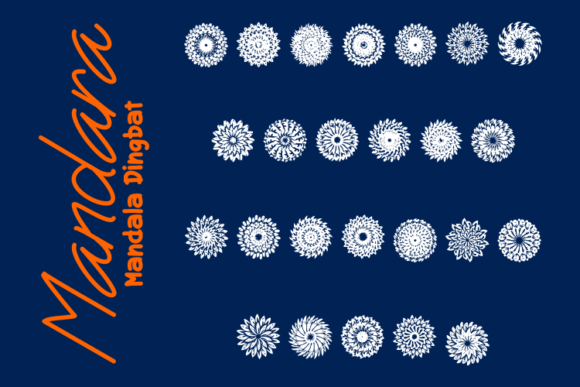
Mandara: A Decorative Dingbats Font for Handmade Mandala Art
Few typefaces capture the intersection of precision and artistry quite like Mandara. At first glance, it presents itself as a dingbats font, but to call it merely that undersells its depth. Mandara is a meticulously crafted collection of handmade mandala designs, each glyph carrying the symmetry and meditative quality of traditional mandala art. Whether you are a graphic designer searching for ornamental accents or a small business owner looking to elevate your brand identity, Mandara offers an original, decorative purpose that sets it apart from conventional dingbat fonts.
What Makes Mandara a Distinctive Dingbats Font?
Most dingbats fonts rely on generic symbols, arrows, or ornamental flourishes. Mandara takes a different approach by centering its entire character set on hand-drawn mandala motifs. Each letterform, numeral, and punctuation mark has been reimagined as a standalone mandala design, allowing you to type entire patterns without ever opening a vector editor. The result is a font that functions both as a practical typesetting tool and as a source of original decorative artwork.
The handmade quality of Mandara is immediately apparent. Unlike digitally generated patterns that can feel sterile, these mandalas carry subtle variations in line weight, curve flow, and spacing that give each glyph a human touch. This authenticity makes Mandara particularly valuable for projects where warmth, craftsmanship, and organic beauty are desired.
Core Features of the Mandara Font
- Complete mandala character map: Every key on your keyboard corresponds to a unique mandala design, from simple circular motifs to intricate radial patterns.
- Handmade aesthetic: Each glyph is drawn with care, preserving the irregularity and charm of hand-drawn art while maintaining typographic consistency.
- Scalable vector format: As a true type font, Mandara remains crisp at any size, making it suitable for everything from web icons to large-format posters.
- Decorative versatility: The designs range from minimalist single-line mandalas to dense, detailed patterns, giving you flexibility across different projects.
- Easy accessibility: No special software or design skills are required — simply install the font and type your way to stunning mandala compositions.
Who Benefits Most from Using Mandara?
The appeal of Mandara extends across multiple creative and professional domains. Understanding who can leverage this font most effectively helps you determine if it aligns with your own needs.
Graphic Designers and Visual Creators
For designers, Mandara eliminates the time-consuming process of sourcing or creating individual mandala vectors. Need a circular border for a certificate? Type a few characters. Building a pattern for a branding project? Arrange multiple glyphs in layers. The font becomes a generative toolkit that speeds up workflows while maintaining artistic quality. Designers working on bohemian, spiritual, or nature-inspired themes will find Mandara particularly useful.
Small Business Owners and Entrepreneurs
Businesses in wellness, yoga, holistic health, or handmade crafts can use Mandara to create cohesive branding materials without hiring an illustrator. Product labels, business cards, website headers, and social media graphics gain a consistent decorative language. The font helps small brands project a polished, intentional image that resonates with customers seeking authenticity and mindfulness.
Wedding and Event Planners
Mandala motifs are a staple in wedding stationery, event programs, and celebration decor. Mandara allows planners and couples to generate custom patterns for invitations, place cards, thank-you notes, and even table numbers. The handwritten quality of the font pairs beautifully with calligraphy and script typefaces, creating layered, textural designs that feel both modern and timeless.
DIY Enthusiasts and Hobbyists
Even without formal design training, anyone can use Mandara to enhance personal projects. Scrapbooking, bullet journaling, home decor printables, and greeting cards all benefit from the addition of genuine mandala artwork. The font removes the barrier of drawing skill, letting you focus on composition and color.
Real-World Applications of Mandara
The theoretical uses of Mandara are broad, but concrete examples help clarify its value. Consider the following scenarios where this dingbats font transforms an ordinary project into something memorable.
Example 1: Yoga Studio Branding
A boutique yoga studio needs a logo, class schedule, and promotional flyers. Instead of hiring an illustrator to create custom mandala elements, the owner installs Mandara and types the studio's name using the font's decorative glyphs. The individual letters themselves are mandalas, forming a logo that is both readable and inherently artistic. For flyers, the studio uses the font to generate border patterns that frame class information, creating a cohesive visual identity across all materials.
Example 2: Wedding Invitation Suite
A couple planning a bohemian wedding wants invitations that feel personal and handcrafted. Using Mandara, they create intricate mandala borders around each invitation card. The RSVP cards feature a central mandala motif that echoes the main design. The font allows them to produce multiple pieces with consistent ornamentation, saving both time and money while achieving a bespoke look.
Example 3: Children's Activity Worksheets
An educator designing mindfulness activities for children uses Mandara to create coloring pages and pattern-recognition exercises. By typing different mandala glyphs at various sizes, she generates worksheets that encourage focus and creativity. The handmade quality of the font makes the designs feel approachable rather than intimidating.
Strengths and Considerations When Using Mandara
Like any specialized tool, Mandara comes with distinct strengths and a few limitations. Understanding these helps you decide if it is the right fit for your project.
Strengths of Mandara
- Originality: Because each glyph is a unique mandala design, your work will not look like it came from a generic clip-art library. The font brings a level of originality that supports authentic creative expression.
- Efficiency: Typing mandalas is far faster than drawing them by hand or piecing together vector assets. Projects that would take hours can be completed in minutes.
- Consistency: All glyphs share a cohesive visual language, ensuring that any combination of characters feels unified. This is crucial for branding and professional presentations.
- Accessibility: No steep learning curve. Anyone who can install a font and type can start creating immediately.
Considerations and Limitations
- Specialized use case: Mandara is not a general-purpose text font. It is best suited for decorative, ornamental, and accent applications. Reading long passages set in Mandara would be difficult.
- Character recognition: Because each letterform is a mandala, some characters may not be immediately recognizable as letters or numbers. This is intended, but it can be a barrier if legibility is critical.
- Pairing with other fonts: For projects that require both decorative elements and readable text, you will need to pair Mandara with a clean, legible typeface. This is a standard practice and not a flaw, but it requires deliberate planning.
- File size and rendering: Depending on the complexity of the mandala designs, the font file may be larger than typical text fonts. This is rarely an issue for print projects, but web usage may require subsetting or optimization.
How to Evaluate if Mandara Is Right for You
Before investing time and resources into any design tool, it helps to ask targeted questions. Here is a simple framework to assess whether Mandara aligns with your creative or professional goals.
Consider Your Project's Visual Language
Does your project call for organic, symmetrical, or meditative imagery? Mandara thrives in contexts where mandala motifs feel natural. If your brand or message is aligned with themes of balance, spirituality, nature, or craftsmanship, the font will amplify that identity. Conversely, if your work demands hard edges, modern minimalism, or industrial aesthetics, Mandara may feel out of place.
Assess Your Workflow Needs
Are you currently spending significant time sourcing or creating decorative elements? If so, Mandara can dramatically streamline your process. For designers who already have a library of vector mandalas, the value may be more about consistency and typing speed rather than access to new designs.
Evaluate Your Technical Comfort
Mandara is exceptionally easy to use, but some creative exploration is required. Because the font maps mandalas to keyboard characters, you will need to experiment with different key combinations to see which glyphs work best for your layout. A willingness to test and iterate is helpful.
Practical Tips for Getting the Most Out of Mandara
Once you have decided to use Mandara, a few practical strategies can help you maximize its potential.
- Layer multiple glyphs: Combine different Mandara characters at varying sizes and opacities to create complex, textured patterns. The font supports layering just like any other typeface.
- Experiment with color: Mandalas often shine in monochromatic schemes, but contrasting colors can highlight specific glyphs or create dynamic compositions.
- Use as a background element: Set Mandara text in a light color or low opacity behind readable content. This adds depth without competing with the main message.
- Pair with a neutral font: Combine Mandara with a simple sans-serif or serif typeface for headings and body text. The contrast between decorative and functional fonts creates visual hierarchy.
- Create custom patterns: Type a sequence of Mandara glyphs, adjust spacing, and repeat the row to form seamless patterns for wrapping paper, fabric prints, or digital backgrounds.
The Artistic Value of Handmade Mandala Designs
At its core, Mandara is more than a utility. It is an invitation to incorporate centuries-old artistic tradition into modern design workflows. Mandala creation has historically been a meditative practice, requiring patience and steady hands. By translating this art into a dingbats font, Mandara preserves the spirit of handmade mandalas while making them accessible to a wider audience.
The font encourages creativity even in small doses. Typing a single Mandara glyph as a bullet point transforms a plain list into a visual statement. Using the font for section dividers adds elegance to long documents. For creators who value both efficiency and artistry, Mandara offers a rare combination of speed and soul.
Final Thoughts on Adding Mandara to Your Creative Toolkit
Mandara stands out in the landscape of dingbats fonts because it delivers genuine handmade mandala designs in a format that any computer user can operate. Its original, decorative purpose makes it suitable for everything from professional branding to personal projects, and its strengths far outweigh its limitations when applied thoughtfully.
Whether you are a seasoned designer looking to expand your ornamental options, a business owner building a cohesive visual identity, or a creative hobbyist exploring new ways to enhance your work, Mandara provides a direct path to incorporating authentic mandala art into your creations. The font bridges the gap between traditional craftsmanship and digital convenience, letting you enhance your artistic side with every keystroke.
As you consider your next project, think about the role decoration plays in your design. A well-chosen ornamental element can elevate the ordinary into the memorable. With Mandara, you have an entire library of handmade mandalas ready to type, layer, and explore. The only question left is what you will create.